Dashed Numbered Letters Tracing: Enhancing Handwriting Instruction Through Structured Design
Understanding the Structure Behind Dashed Numbered Letters Tracing
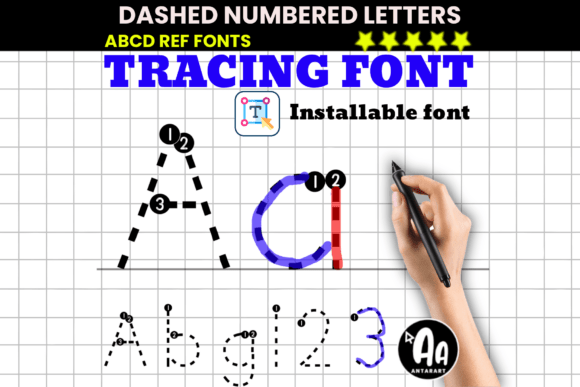
The Dashed Numbered Letters Tracing system is more than a font — it's a structured learning tool designed to support early writing development. Unlike standard fonts, this design incorporates dashed outlines and numbered stroke indicators to guide users through the proper sequence of letter formation. Each letter, whether uppercase or lowercase, is carefully constructed to reflect traditional handwriting styles while offering a visual roadmap for correct stroke order.
This approach aligns with how young learners are taught to write in many school systems, particularly those that emphasize consistency and muscle memory in handwriting instruction. The numbered strokes act as a scaffold, allowing children to trace each letter step by step. Over time, this structured repetition helps them internalize the mechanics of writing, making the transition from guided tracing to independent writing smoother and more intuitive.
How Dashed Numbered Letters Tracing Supports Educational Development
One of the most compelling aspects of this font is its dual role in supporting both letter recognition and letter formation. For educators and parents, this is a valuable combination. The visual cues provided by the numbered dashes serve as a built-in teaching aid, reinforcing correct letter shapes while also improving fine motor skills and hand-eye coordination.
- Improves muscle memory: Repeated tracing along numbered strokes helps learners develop consistent handwriting habits.
- Encourages independent writing: As children become familiar with the patterns, they begin to write without relying on constant visual guidance.
- Supports early literacy: Recognizing and forming letters correctly is a foundational skill in reading and writing development.
Additionally, the font includes numbers 0–9 and common symbols, making it a versatile tool for broader literacy and numeracy instruction. While it does not support Spanish characters, it remains widely applicable across English-language educational materials and beyond.
Applications in the Classroom and Beyond
Educators can integrate Dashed Numbered Letters Tracing into a variety of instructional formats. It’s particularly effective when used in printable worksheets, interactive whiteboard activities, or editable name templates that personalize learning experiences. The font’s compatibility with widely used software like Microsoft Word, PowerPoint, Canva Pro, and Adobe applications ensures that teachers and creators can easily incorporate it into existing workflows.
For example, a teacher designing a back-to-school review packet might use the font to create tracing sheets that reinforce letter recognition. Similarly, a homeschooling parent could generate custom alphabet practice pages tailored to their child’s pace and learning style. In both cases, the font supports a hands-on, engaging approach to handwriting instruction that aligns with best practices in early childhood education.
Who Benefits Most from This Tracing Font?
While Dashed Numbered Letters Tracing is particularly effective for early learners, its utility extends to a broader audience. Here’s a look at some key user groups who may find it especially beneficial:
- Early childhood educators: Looking for developmentally appropriate tools to teach handwriting in a structured yet engaging way.
- Parents and homeschoolers: Seeking customizable, print-at-home resources for handwriting practice.
- Graphic designers and content creators: Developing educational materials, such as alphabet charts or classroom décor, that require clarity and instructional value.
- Curriculum developers: Designing digital or print-based literacy programs that emphasize proper letter formation as part of foundational skills.
Because of its straightforward design and compatibility with a wide range of tools, this font is also well-suited for professionals who create digital content for educational platforms or printable resource marketplaces. Its flexibility allows for creative application across formats, from flashcards to interactive PDFs.
Design Considerations and Limitations
While the Dashed Numbered Letters Tracing font is a powerful educational resource, it’s important to understand its limitations. As noted, it does not include support for Spanish characters, which may limit its use in bilingual or multilingual settings. Educators working in Spanish immersion programs or dual-language classrooms may need to supplement with other fonts or handwriting systems that include accented characters and special symbols.
Additionally, while the font is optimized for clarity and instructional use, it may not be suitable for decorative or stylistic applications. Its primary strength lies in function rather than form — making it ideal for worksheets, practice sheets, and instructional signage, but less appropriate for branding or artistic design projects that require visual flair.
Integrating Dashed Numbered Letters Tracing into Digital and Print Workflows
Thanks to its broad software compatibility, integrating this font into digital and print-based projects is straightforward. Here’s how it works across some of the most commonly used platforms:
- Microsoft Word and PowerPoint: Install the font and use it in worksheets, presentations, or classroom handouts.
- Canva Pro: Upload the font (if supported) or use it in downloaded templates to create visually engaging educational graphics.
- Adobe Illustrator and Photoshop: Ideal for creating scalable vector graphics for posters, flashcards, or digital tracing exercises.
- Inkscape and GIMP: Open-source alternatives that support the font for educators and creators on a budget.
Once installed, the font behaves like any other system font, making it easy to incorporate into lesson plans, student templates, or printable resources. Its adaptability ensures that it can be used in both digital and physical formats, supporting a blended approach to handwriting instruction.
Real-World Examples of Effective Use
Consider a first-grade classroom where students are just beginning to learn cursive writing. A teacher might use the font to create tracing worksheets that demonstrate the correct stroke order for each letter. These sheets can be printed and used with dry-erase sleeves for repeated practice, or integrated into digital tablets for interactive tracing exercises.
In another scenario, a homeschooling parent could use the font to design personalized name tracing sheets for their child. By allowing the child to repeatedly trace their own name, the parent reinforces both letter recognition and personal identity in a meaningful way. The font’s structured format ensures that each letter is formed correctly, reducing the risk of developing bad handwriting habits early on.
Final Thoughts on Dashed Numbered Letters Tracing
The Dashed Numbered Letters Tracing font represents a thoughtful blend of design and pedagogy. By embedding instructional cues directly into the letterforms, it transforms a simple font into a powerful teaching tool. Whether used in the classroom, at home, or in digital content creation, it supports a structured, step-by-step approach to handwriting that aligns with modern educational best practices.
Its versatility, compatibility, and clear visual guidance make it a valuable asset for anyone involved in early literacy instruction. While it may not be the most stylistically diverse font, its strength lies in its ability to support learning — making it a standout choice for educators, parents, and creators who prioritize function and educational impact over aesthetics alone.